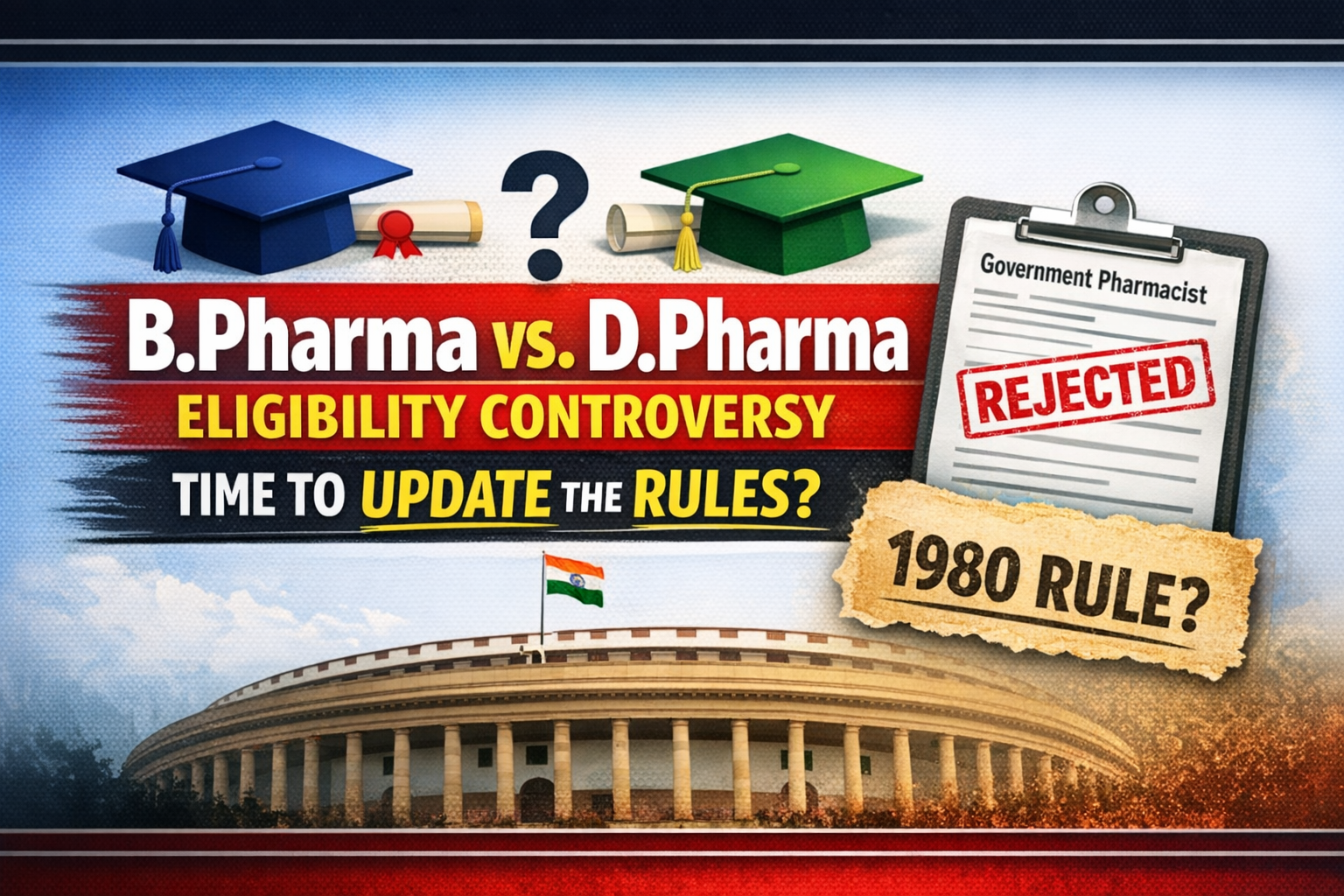
The B.Pharma vs. D.Pharma Eligibility Controversy: Is It Time to Update the Rules?
Introduction
A significant debate has recently taken center stage in the Indian healthcare and education sector, specifically concerning the recruitment of Government Pharmacists. For years, students have pursued higher education in pharmacy with the hope of serving the nation, but recent legal and administrative decisions have left thousands of Bachelor of Pharmacy (B.Pharma) graduates questioning their future.
The core of the issue lies in the exclusion of B.Pharma graduates from eligibility for certain government pharmacist posts, restricting these opportunities solely to Diploma in Pharmacy (D.Pharma) holders.
The Trigger: Patna High Court and UPSSSC Decisions
The conversation gained momentum following a decisive ruling by the Patna High Court, which stated that for specific government pharmacist recruitments, B.Pharma graduates are not eligible—only D.Pharma candidates are.
Adding to the concern, recent news regarding the Uttar Pradesh Subordinate Services Selection Commission (UPSSSC) recruitment drives suggests a similar trend. Notifications indicate that for upcoming vacancies in Uttar Pradesh, the eligibility criteria may strictly require a Diploma in Pharmacy, effectively barring degree holders from applying.
The Inconsistency in Recruitment Standards
This exclusion has raised eyebrows because it contradicts the eligibility criteria of many other prestigious central government bodies. For instance, recruitment drives conducted by:
-
Indian Railways (RRB)
-
Employees’ State Insurance Corporation (ESIC)
-
King George’s Medical University (KGMU)
In these organizations, B.Pharma graduates are not only eligible but are often encouraged to apply. This lack of uniformity between state-level recruitments (like Bihar and UP) and central bodies creates confusion and frustration among aspirants.
The “1980 Rule”: An Outdated Justification?
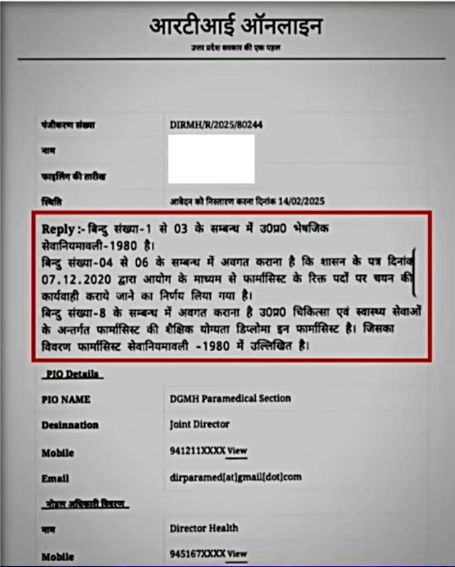
Why is this happening? An RTI (Right to Information) query filed to understand the reasoning behind excluding B.Pharma graduates revealed a surprising fact. The authorities cited a Departmental Manual from 1980.
According to this 44-year-old rule, the specified qualification for the post is a Diploma. The authorities are technically following the rulebook. However, this leads to a critical question: Are rules framed in 1980 still relevant in 2024-2026? The landscape of medical education and the complexity of pharmaceutical sciences have evolved drastically over the last four decades.
Key Questions for the Government and PCI
We are not advocating for a conflict between Diploma and Degree students. However, we must ask the Government of India and the Pharmacy Council of India (PCI) some hard questions:
-
Why the Disparity? If a candidate possesses a higher qualification (Bachelor’s Degree) in the same field, logically, they should be eligible for a post requiring a lower qualification (Diploma), as seen in engineering and other sectors.
-
The Future of B.Pharma Colleges: If B.Pharma graduates are ineligible for government pharmacist jobs, what is the utility of the hundreds of institutions offering this degree?
-
Where is the Regulatory Body? When issues arise regarding medical students (MBBS), the Medical Council (now NMC) intervenes immediately to protect student interests. We urge the Pharmacy Council of India (PCI) to step in and update these recruitment rules to reflect modern educational standards.
Conclusion
This post is not intended to pit B.Pharma students against D.Pharma students. Both are integral parts of the healthcare ecosystem. However, relying on a rule from 1980 to dictate recruitment in the 21st century is a regression.
We appeal to the higher authorities to review these guidelines. Merit and higher education should be rewarded, not penalized. It is time for a unified eligibility criterion that honors the hard work of all pharmacy students.