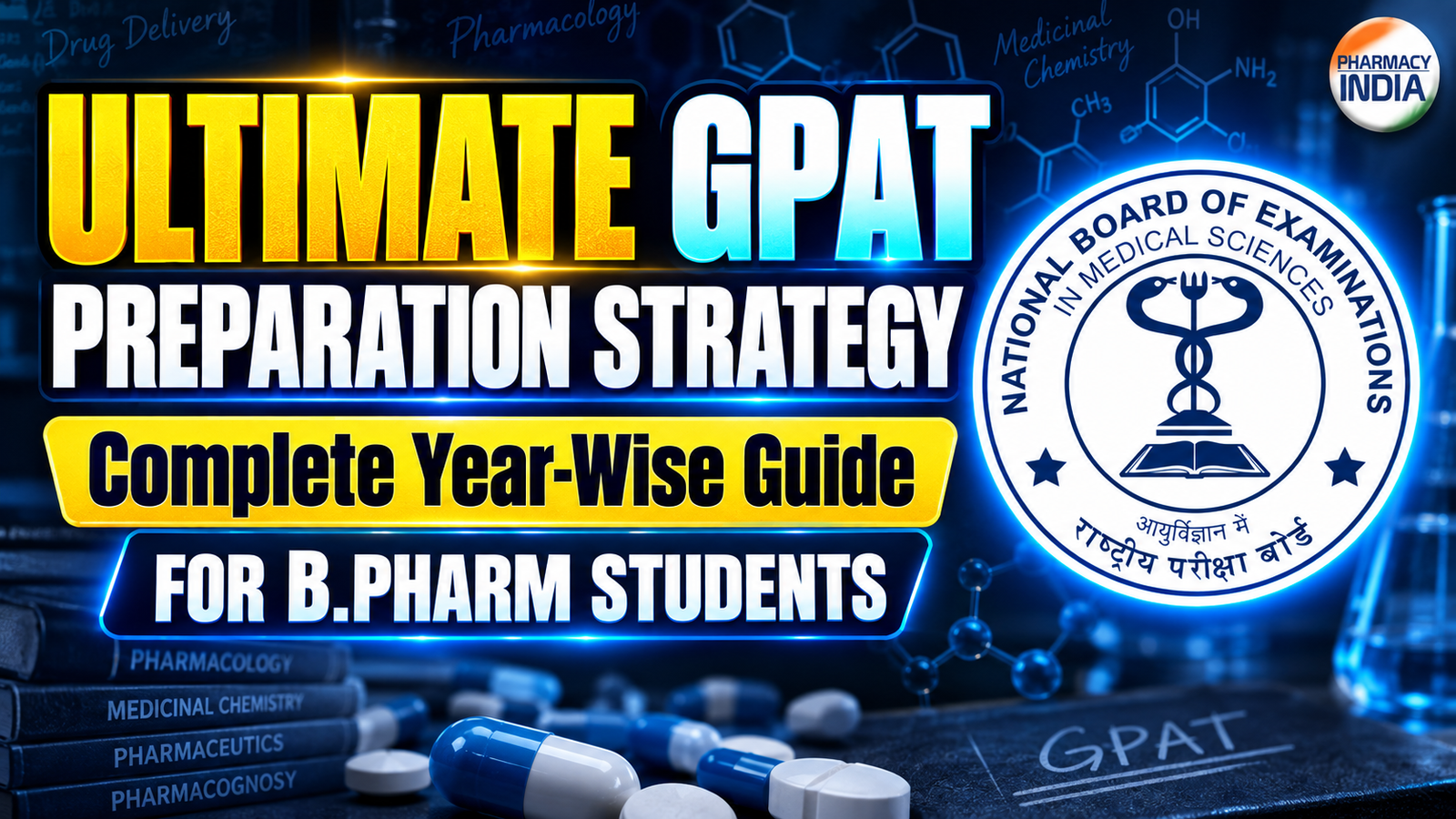
Comprehensive GPAT Preparation Guide for B.Pharm Students (Year-Wise Strategy)
| Subject Information |
|---|
| The Graduate Pharmacy Aptitude Test (GPAT) is a national-level entrance exam for M.Pharm and pharmaceutical careers. Starting early is the key to success. This guide provides a detailed roadmap from the 1st year to the Final year of B.Pharm to ensure a top rank. |
1. The Ideal Preparation Timeline
| B.Pharm Year | Preparation Level | Main Objective |
|---|---|---|
| 1st Year | Foundation Phase | Build strong basic concepts in core science subjects. |
| 2nd Year | Start Phase (Best Time) | Concept building, making notes, and solving basic MCQs. |
| 3rd Year | Intensive Phase | Complete major subjects and practice Previous Year Questions (PYQs). |
| Final Year | Revision Phase | Full-length Mock Tests, quick revision, and exam strategy. |
2. B.Pharm 1st & 2nd Year Strategy
1st Year: Building Foundations
- Focus on Human Anatomy, Pharmaceutical Analysis, and Biochemistry.
- Understand concepts instead of rote memorization.
- Start learning important definitions, classifications, and basic formulas.
2nd Year: The Ideal Time to Begin
- Devote 1–2 hours daily consistently for GPAT.
- Start subject-wise MCQ practice alongside college studies.
- Prepare concise revision notes for long-term retention.
- Identify weak subjects early to avoid final-year pressure.
3. Subject-Wise Approach (Categorization)
| Category | Subjects Included | Preparation Strategy |
|---|---|---|
| Concept-Based | Pharmaceutics, Pharmacology, Analysis, Organic Chemistry | Focus on Mechanism of Action and deep understanding. |
| Memory-Based | Pharmacognosy, Jurisprudence, Drug Classifications | Use Tables, Charts, and Mnemonics for frequent revision. |
| Calculation-Based | Physical Pharmaceutics, Pharmaceutical Calculations | Maintain a Formula Notebook and solve numericals daily. |
4. Effective Preparation Cycle for 3rd Year
The Golden Cycle: Concept → Short Notes → Topic-wise MCQs → PYQs → Multiple Revisions.
- Pharmacology: Focus on classifications, adverse effects, and contraindications.
- Pharmacognosy: Focus on chemical constituents and morphological characteristics.
- Pharmaceutics: Cover dosage forms, stability testing, and industrial pharmacy.
5. Final Year: Testing & Revision Phase
| Activity | Importance / Goal |
|---|---|
| Mistake Notebook | Note down repeatedly incorrectly answered MCQs for final day review. |
| Full Mock Tests | Practice Time Management and analyze unattempted questions. |
| PYQ Analysis | Understand question styles and difficulty levels from the last 10 years. |
| One-Liners | Quickly revise important facts and formulas in the final month. |
6. Daily Routine & Common Mistakes to Avoid
Recommended 2-Hour Daily Routine:
- 60 Minutes: New Concept / Theory Study.
- 30 Minutes: MCQ Practice (Topic-wise).
- 20 Minutes: Revision of previous day’s topics.
- 10 Minutes: Updating Formula/Mistake Notebook.
Common Mistakes to Avoid:
- Using Too Many Books: Stick to 1-2 standard references and revise them.
- Ignoring Weak Subjects: Strengthen difficult topics early rather than skipping them.
- Reading Only Theory: GPAT is objective; MCQ practice is mandatory.
- Studying Without Revision: Information is lost without periodic revision cycles.
Final Tip: Start Early → Study Consistently → Practice MCQs → Revise Repeatedly → Success!