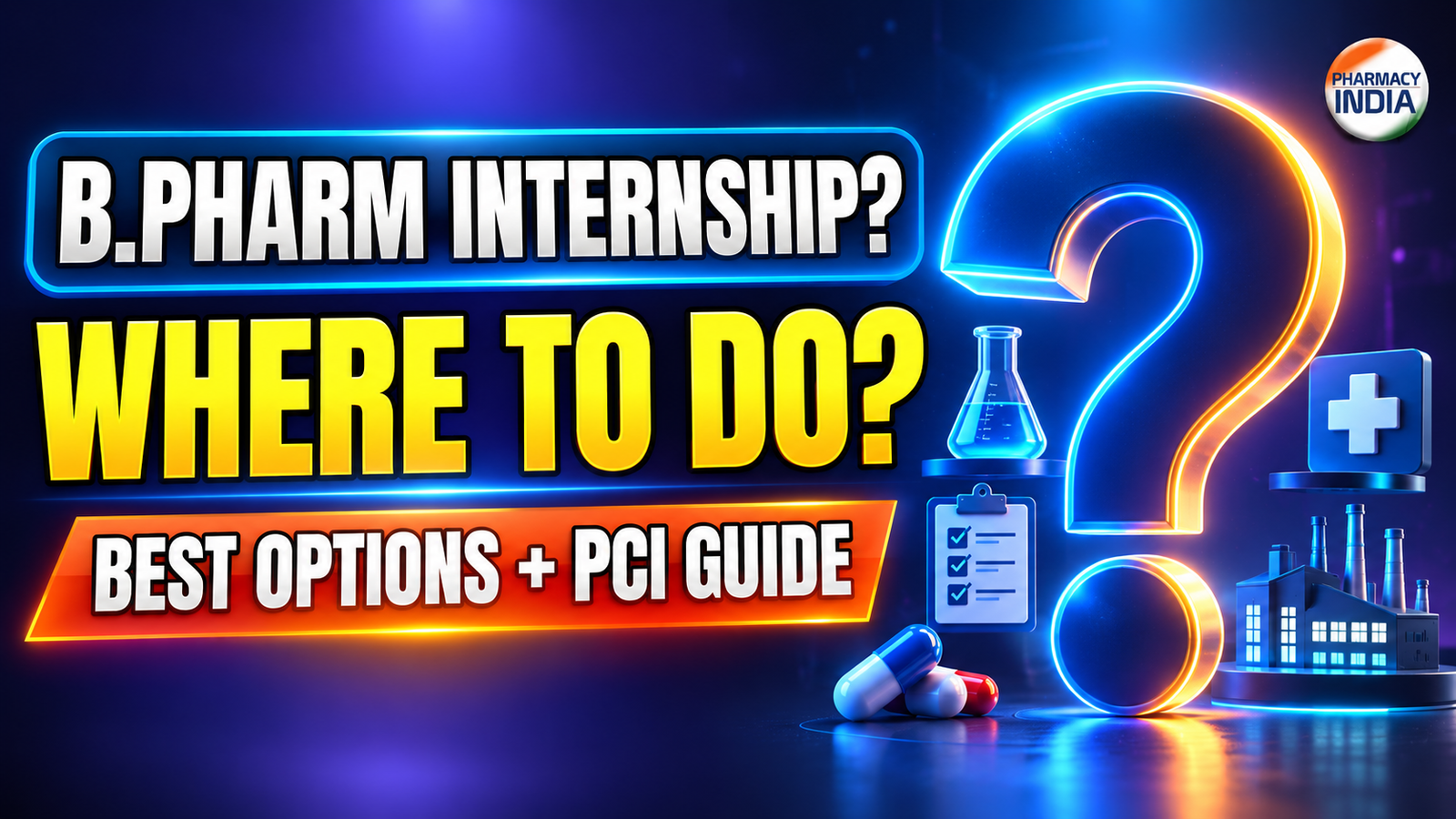
Where Can B.Pharm Students Do Internship? Best Internship Options, PCI Practical Training Requirement & Career Guide
Pharmaceutical Industry • QA • QC • Production • R&D • Hospital • CRO • Pharmacovigilance • Regulatory Affairs| Short Information |
|---|
|
An internship or practical training is an important part of a
B.Pharm student’s professional development. It gives students
real-world exposure to areas such as
pharmaceutical manufacturing, Quality Assurance (QA),
Quality Control (QC), Production, Research & Development (R&D),
hospital pharmacy, clinical research, pharmacovigilance,
regulatory affairs and community pharmacy.
A suitable internship can help a student understand how the pharmaceutical sector works while improving practical skills, industry knowledge, professional exposure, CV quality and future employment opportunities. Students should select an internship according to their career goal and should confirm that the training is acceptable to their college/university when it is being completed as part of an academic requirement. |
B.Pharm Internship / Practical Training Requirement
| Requirement | Details |
|---|---|
| Course | Bachelor of Pharmacy (B.Pharm) |
| Practical Training Duration | 150 hours of practical training. |
| Minimum Training Period | Training is to be spread over a period of not less than one month. |
| Permitted Area – Option A | Pharmacy Practice – Hospital Pharmacy or Community Pharmacy. |
| Permitted Area – Option B | Pharmaceutical and Allied Industries. |
| When Training Can Be Undertaken | According to the B.Pharm Course Regulations, 2014, practical training can be undertaken during the course of study after the second year. |
| PCI Syllabus Industrial Training | The PCI B.Pharm syllabus describes industrial training of at least 150 hours spread over four weeks and includes areas such as Production, QC, QA, analytical laboratories, pharmaceutical R&D, hospitals, CROs and community pharmacy. |
| Academic Approval | Students should confirm the training duration, organization, department and required documents with their college/university or training coordinator before joining. |
Best Places for B.Pharm Students to Do Internship
B.Pharm students can explore several areas of the pharmaceutical and healthcare sector. The most suitable choice depends on the student’s career interest and future professional goal.
| No. | Internship Area | Major Exposure / Learning | Best For |
|---|---|---|---|
| 1 | Pharmaceutical Manufacturing Company | Production, QA, QC, Formulation & Development, R&D, Packaging, Warehouse, Documentation, Validation and Regulatory Affairs. | Production, QA, QC, R&D and Regulatory Affairs careers. |
| 2 | Quality Control (QC) | Raw-material testing, finished-product testing, in-process testing, dissolution, assay, stability studies and analytical instruments. | QC, Pharmaceutical Analysis and Analytical R&D. |
| 3 | Quality Assurance (QA) | GMP, SOPs, batch records, documentation, CAPA, deviation, change control, validation, qualification and audits. | QA, Compliance, Validation and Documentation. |
| 4 | Production Department | Manufacturing of tablets, capsules, syrups, suspensions, creams, ointments, injectables and other dosage forms. | Production Pharmacist, Manufacturing Officer or Production Executive. |
| 5 | Research & Development (R&D) | Pre-formulation, formulation development, trial batches, optimization, stability and analytical method development. | M.Pharm, research and formulation-development careers. |
| 6 | Hospital Pharmacy | Prescription handling, dispensing, inventory, drug storage, patient counselling, drug information and hospital formulary. | Hospital Pharmacist and patient-oriented pharmacy services. |
| 7 | Community / Retail Pharmacy | Prescription reading, dispensing, OTC medicines, patient counselling, inventory and expiry management. | Community Pharmacist and pharmacy-related businesses. |
| 8 | Clinical Research Organization (CRO) | Clinical trials, GCP, trial documentation, data management, medical writing, monitoring support and pharmacovigilance. | Clinical Research, Clinical Data Management and Drug Safety. |
| 9 | Pharmacovigilance / Drug Safety | ADRs, ICSR, case assessment, causality assessment, drug-safety databases, literature surveillance and signal basics. | Pharmacovigilance and Drug Safety careers. |
| 10 | Regulatory Affairs | Product registration, dossier preparation, CTD/eCTD, licensing, labelling and regulatory documentation. | Regulatory, compliance and pharmaceutical documentation careers. |
| 11 | Pharmaceutical Analytical Laboratory | Instrumental analysis, pharmaceutical testing, stability testing and analytical documentation. | Laboratory, QC and analytical careers. |
| 12 | Clinical / Diagnostic / Research Institution | Research institutes, academic laboratories, biotechnology laboratories, government research institutions and drug-testing laboratories. | Pharmaceutical and academic research careers. |
| 13 | Biotechnology / Biopharmaceutical Company | Biopharmaceuticals, vaccines, recombinant products, biological products, biosimilars and bioprocessing. | Biotechnology and biopharmaceutical careers. |
| 14 | Herbal / Ayurvedic Pharmaceutical Industry | Herbal raw materials, extraction, formulation, standardization, QC, manufacturing and packaging. | Pharmacognosy, natural products and herbal medicines. |
| 15 | Cosmetic Industry | Creams, lotions, shampoos, gels, formulation, product development, testing, manufacturing and packaging. | Cosmetic formulation, development, manufacturing and QC. |
| 16 | Nutraceutical Industry | Vitamins, minerals, protein products, dietary supplements and functional-food products. | Formulation, QA, QC and nutraceutical manufacturing. |
A pharmaceutical manufacturing company is one of the most useful internship options for B.Pharm students who want to develop a career in the pharmaceutical industry.
Departments Students May Explore
- Production
- Quality Assurance (QA)
- Quality Control (QC)
- Formulation & Development
- Research & Development (R&D)
- Packaging
- Warehouse
- Documentation
- Validation
- Regulatory Affairs
What Students Can Learn
- Tablet and capsule manufacturing
- Liquid and semisolid dosage forms
- Granulation and compression
- Tablet coating processes
- Good Manufacturing Practices (GMP)
- Batch Manufacturing Records
- Standard Operating Procedures
- In-process quality checks
- Pharmaceutical documentation
- Quality Management Systems
Quality Control is an excellent option for students who are interested in laboratory-based pharmaceutical careers and pharmaceutical analysis.
Possible Training Exposure
- Raw-material testing
- Finished-product testing
- In-process testing
- Analytical instruments
- Stability studies
- Dissolution testing
- Assay
- Identification tests
- Pharmaceutical analysis
- Laboratory documentation
Analytical Instruments Students May Observe
- HPLC
- UV-Visible Spectrophotometer
- Dissolution Apparatus
- Disintegration Tester
- Friability Tester
- pH Meter
- Analytical Balance
Quality Assurance is one of the key departments of a pharmaceutical organization. Students interested in documentation, compliance and pharmaceutical quality systems may find QA particularly useful.
Major Areas of Exposure
- Good Manufacturing Practices (GMP)
- SOP preparation and control
- Batch records
- Documentation systems
- Line clearance
- Deviation management
- Change control
- Corrective and Preventive Action (CAPA)
- Validation
- Qualification
- Internal audits
- Quality Management Systems
Students who are interested in the actual manufacturing of pharmaceutical dosage forms can consider training in a Production Department.
Dosage Forms Students May Observe
- Tablets
- Capsules
- Syrups
- Suspensions
- Creams
- Ointments
- Injectables
- Other pharmaceutical dosage forms
Major Learning Areas
- Manufacturing operations
- Production equipment
- Process control
- Production documentation
- GMP requirements
An R&D internship can be particularly valuable for students interested in formulation development, pharmaceutical research or higher studies.
Possible Areas of Exposure
- Pre-formulation studies
- Formulation development
- Trial batches
- Formulation optimization
- Stability studies
- Analytical method development
- Literature review
- New dosage-form development
B.Pharm students interested in patient-oriented pharmacy practice may undertake suitable training in a hospital pharmacy.
Possible Learning Areas
- Prescription handling
- Medicine dispensing
- Drug storage
- Inventory management
- Hospital formulary
- Medication distribution
- Patient counselling
- Drug information services
- Rational use of medicines
- Pharmacy documentation
Community pharmacy provides direct exposure to medicines, prescriptions and patients.
Students Can Learn About
- Reading prescriptions
- Dispensing medicines
- Drug storage
- Prescription medicines
- OTC medicines
- Patient counselling
- Inventory management
- Expiry management
- Drug schedules
- Pharmacy records
Students interested in clinical research can explore internship opportunities with a suitable Clinical Research Organization.
Possible Areas
- Clinical trial documentation
- Clinical research basics
- Good Clinical Practice (GCP)
- Clinical data management
- Trial-monitoring support
- Medical writing
- Pharmacovigilance
- Drug safety
Pharmacovigilance is an important pharmaceutical career area concerned with monitoring and understanding medicine safety.
Internship Exposure May Include
- Adverse Drug Reactions – ADRs
- ADR reporting
- Individual Case Safety Reports – ICSR
- Drug-safety databases
- Case assessment
- Causality assessment
- Literature surveillance
- Signal-detection basics
Regulatory Affairs deals with regulatory requirements related to pharmaceutical products and maintaining appropriate documentation and approvals.
Students May Learn About
- Drug regulatory requirements
- Product registration
- Dossier preparation
- CTD/eCTD basics
- Drug licences
- Regulatory documentation
- Labelling requirements
- Compliance
Students can consider pharmaceutical testing or analytical laboratories where appropriate supervision and practical training are available.
Major Areas of Exposure
- Pharmaceutical testing
- Instrumental analysis
- Raw-material analysis
- Finished-product testing
- Stability testing
- Analytical documentation
Depending on the institution and availability of formal training, students interested in research may obtain exposure through suitable scientific and research organizations.
Possible Institutions
- Pharmaceutical research institutes
- Academic research laboratories
- Biotechnology laboratories
- Government research institutions
- Drug-testing laboratories
B.Pharm students interested in biotechnology can explore suitable training opportunities in companies working with biological and biopharmaceutical products.
Possible Areas
- Biopharmaceuticals
- Vaccines
- Recombinant products
- Biological products
- Biosimilars
- Quality testing
- Bioprocessing
Students interested in Pharmacognosy and natural products may consider training with suitable established herbal or phytopharmaceutical organizations.
Possible Exposure
- Herbal raw-material identification
- Extraction
- Herbal formulation
- Quality control
- Standardization
- Manufacturing
- Packaging
Students interested in formulation can also explore appropriate training opportunities in cosmetic manufacturing and product development.
Possible Training Exposure
- Creams
- Lotions
- Shampoos
- Gels
- Cosmetic formulations
- Quality testing
- Manufacturing
- Packaging
- Product development
The nutraceutical sector can provide B.Pharm students with exposure to the development and manufacturing of different nutrition-related products.
Possible Product Areas
- Vitamins
- Minerals
- Protein products
- Dietary supplements
- Functional-food products
Which Internship Is Best for You?
| Career Goal | Recommended Internship Area | Major Skills / Exposure |
|---|---|---|
| Production Job | Pharmaceutical Manufacturing / Production | Manufacturing process, GMP, equipment and production documentation |
| Quality Assurance | QA Department | GMP, SOPs, CAPA, validation, audits and documentation |
| Quality Control | QC / Analytical Laboratory | Testing, analytical instruments, stability, assay and documentation |
| Research Career | R&D / Formulation Development | Pre-formulation, formulation trials, optimization and research |
| M.Pharm Preparation | R&D / QC / Research Institute | Research exposure, analytical work and scientific documentation |
| Hospital Pharmacist | Hospital Pharmacy | Dispensing, inventory, drug information and patient counselling |
| Community Pharmacist | Community Pharmacy | Prescription handling, dispensing and patient interaction |
| Clinical Research | Clinical Research Organization – CRO | Clinical trials, GCP, documentation and data management |
| Drug Safety | Pharmacovigilance | ADR reporting, ICSR, case processing and safety monitoring |
| Regulatory Career | Regulatory Affairs | Dossiers, registration, licensing and compliance |
| Analytical Career | QC / Analytical R&D | Instrumental analysis, pharmaceutical testing and analytical documentation |
| Herbal Industry | Herbal Pharmaceutical Company | Natural products, extraction, standardization and herbal formulation |
| Biopharma Career | Biotechnology / Biopharmaceutical Company | Biopharmaceuticals, biological products and bioprocessing |
Best Internship Choice for Most B.Pharm Students
Such training allows students to understand several core functions of the pharmaceutical industry before deciding which department they would like to pursue after completing B.Pharm.
When Should B.Pharm Students Do an Internship?
Training should be completed according to the requirements of the student’s university, college and applicable B.Pharm curriculum.
- Start searching for an internship well in advance.
- Avoid waiting until the last moment to contact pharmaceutical companies.
- Confirm the required training duration with your college.
- Confirm whether the selected organization is suitable for academic submission.
- Check whether a college recommendation letter or NOC is required.
- Confirm the required format of the internship report and completion certificate.
How Can B.Pharm Students Find an Internship?
| No. | Where to Search | What Students Should Do |
|---|---|---|
| 1 | College Training & Placement Cell | Ask whether the college has internship tie-ups with pharmaceutical companies, hospitals or research organizations. |
| 2 | College Faculty | Request guidance and recommendations from faculty members. |
| 3 | Pharmaceutical Company Career Pages | Regularly check official company career and training pages. |
| 4 | Company HR Department | Send a professional internship request with CV and college letter. |
| 5 | Search for internships and connect professionally with HR and industry professionals. | |
| 6 | Internship Portals | Search for appropriate pharmaceutical and healthcare internship opportunities. |
| 7 | Hospital Pharmacy Departments | Contact eligible hospitals regarding pharmacy training opportunities. |
| 8 | CRO Career Pages | Search for clinical research, drug safety or data-management training. |
| 9 | Research Institutes | Check formal student training and research internship programs. |
| 10 | Alumni & Professional Network | Contact seniors and pharmacy professionals for suitable internship leads. |
Documents Usually Required for B.Pharm Internship
| No. | Document | Purpose / Note |
|---|---|---|
| 1 | Updated CV / Resume | Mention academic details, relevant pharmacy skills and contact information. |
| 2 | College ID Card | Proof of current student status. |
| 3 | Bonafide Certificate | May be required by the training organization. |
| 4 | College Recommendation / Request Letter | Formal request from the college for practical training. |
| 5 | Aadhaar / Valid Identity Proof | Submit when requested by the organization. |
| 6 | Recent Photograph | Keep passport-size photographs available if required. |
| 7 | Academic Details | Keep semester/year marks or academic information ready. |
| 8 | NOC | Required only when requested by the institution or company. |
| 9 | Internship Application Letter | A professional application explaining the requested training area and duration. |
What Should a Good B.Pharm Internship Provide?
Students should not select an internship only because an internship certificate is available. The quality of practical exposure is much more important.
| Essential Feature | Why It Matters |
|---|---|
| Practical Exposure | Students should understand actual pharmaceutical or pharmacy operations. |
| Qualified Supervision | Training should ideally be conducted under appropriate professional supervision. |
| Industry Knowledge | Students should understand how the relevant department operates. |
| Relevant Department Training | Training should match the student’s academic or career interest. |
| Proper Internship Certificate | Students should obtain appropriate proof of successful completion. |
Important Advice for B.Pharm Students
- Choose the internship according to your career goal.
- Try to gain actual practical and departmental exposure.
- Learn about GMP, SOPs and pharmaceutical documentation.
- Maintain an internship diary or training report.
- Ask relevant questions and understand the working process.
- Build professional contacts with pharmacists and pharmaceutical-industry professionals.
- Obtain a properly signed training/internship certificate after completing the training.
- Add the internship, department and skills learned to your CV/Resume.
- For academic credit, confirm that the organization and training satisfy your college/university requirements.
Final Recommendation for B.Pharm Students
Pharmaceutical Industry → QA → QC → Production → R&D → Hospital Pharmacy → Clinical Research → Pharmacovigilance → Regulatory Affairs
However, the best internship is different for every student. Students should select a field that matches the career they want to pursue after B.Pharm.
Internship should not be treated only as a certificate requirement. It should be used as the first step toward developing practical skills, professional knowledge and a successful pharmacy career.
Frequently Asked Questions – B.Pharm Internship
| Question | Answer |
|---|---|
| How many hours of practical training are required in B.Pharm? | The B.Pharm Course Regulations, 2014 specify 150 hours of practical training. |
| Can B.Pharm students do training in a hospital? | Yes. Pharmacy Practice can include Hospital Pharmacy. |
| Can B.Pharm students do an internship in a community pharmacy? | Yes. Community Pharmacy is another pharmacy-practice training option. |
| Which internship is best for a Production career? | A pharmaceutical manufacturing or Production Department internship is most relevant. |
| Which internship is best for QA? | Students should preferably seek exposure in a Quality Assurance Department. |
| Which internship is best for QC? | A Quality Control or pharmaceutical analytical laboratory can provide relevant exposure. |
| Which internship is suitable for Pharmacovigilance? | Students can explore Pharmacovigilance, Drug Safety or CRO opportunities. |
| Which internship should I choose if I am confused about my career? | A pharmaceutical manufacturing company giving exposure to Production, QA and QC can help students understand different core pharmaceutical departments. |
| Should I verify the internship with my college? | Yes. Students should confirm the organization, training period and academic requirements with their college/university if the internship is being submitted for academic credit. |
| What should I collect after completing the internship? | Students should obtain a properly signed internship/training certificate and complete any report or diary required by their institution. |
Important Note
Availability of internships, departments and practical exposure may differ from one organization to another.
Complete Pharmacy Education, Career & Job Information for D.Pharm, B.Pharm, M.Pharm and Pharmacy Students.