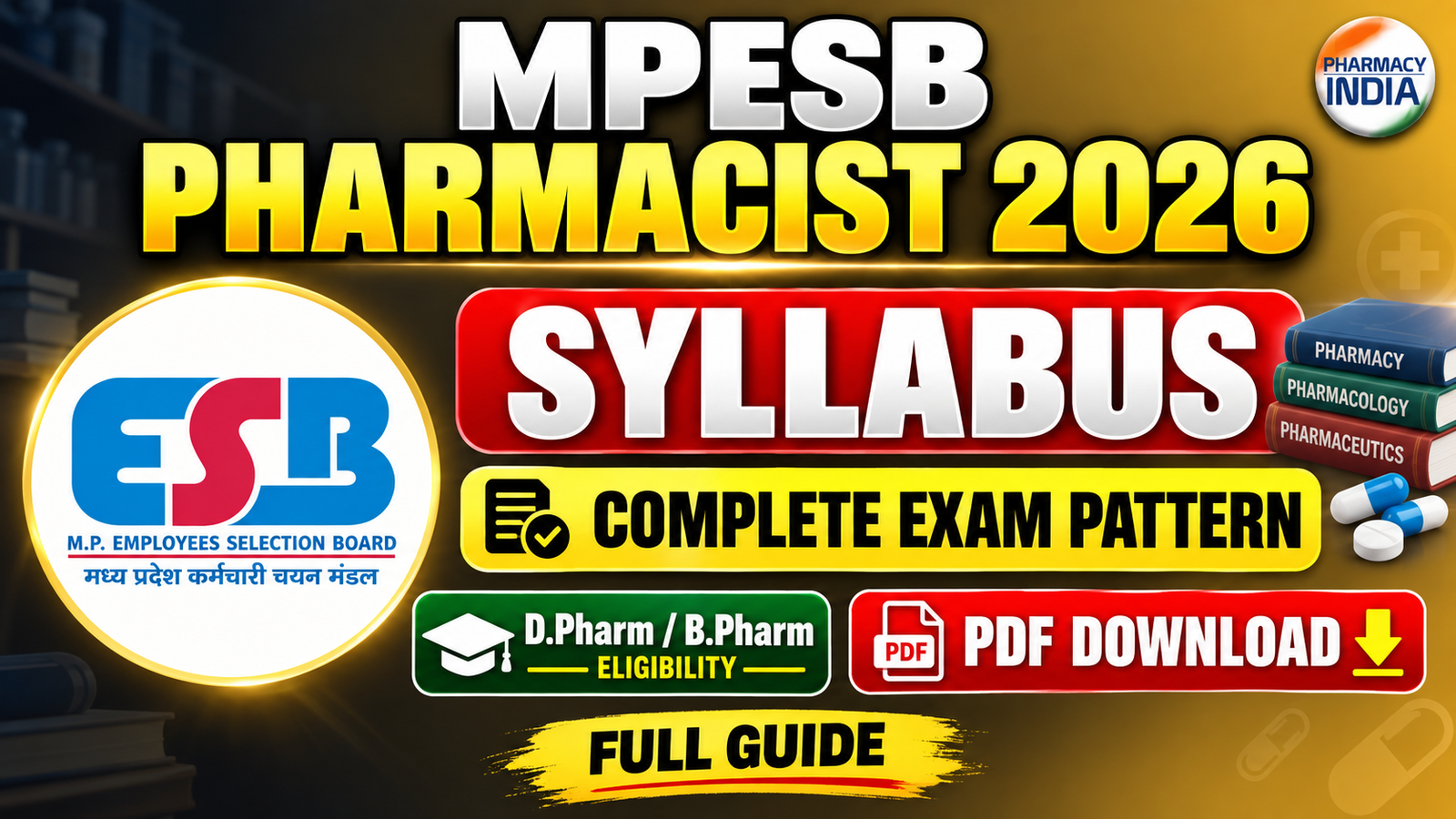
MPESB Pharmacist Syllabus 2026: Complete Exam Pattern & PDF Download

Spread the love

MPESB Pharmacist Syllabus Guide

MPESB Pharmacist Exam 2025: Complete In-Depth Syllabus Guide

Welcome to the complete, detailed syllabus guide for the Madhya Pradesh Employees Selection Board (MPESB) Pharmacist Examination. This guide is specifically curated for Pharmacy students and aspirants looking to secure a government pharmacist position. Below, you will find the comprehensive breakdown of the exam pattern, non-technical subjects, and in-depth pharmacy core subjects required to clear the examination.

Brief Overview of the Exam

MPESB Pharmacist Exam – Short Information
Exam Conducting Body Madhya Pradesh Employees Selection Board (MPESB) / Vyapam
Target Audience Diploma in Pharmacy (D.Pharm) / Bachelor of Pharmacy (B.Pharm) students.
Purpose of Guide To provide a highly detailed, topic-wise syllabus breakdown for strategic exam preparation. (Note: This is a Preparation Guide, not an active recruitment post).

Detailed Exam Pattern

Section Subjects Included Total Marks / Weightage
Part A (Non-Technical) General Knowledge, General Hindi, General English, General Mathematics, General Reasoning, General Science, and Basic Computer Knowledge. 25 Marks
Part B (Technical / Domain) Core Pharmacy Subjects (Pharmaceutics, Pharmacology, Pharmacognosy, Pharmaceutical Chemistry, Jurisprudence, etc.) 75 Marks
Total Maximum Marks 100 Marks

Part B: Core Pharmacy Syllabus (In-Depth Details)

Subject Name Detailed Topics Covered for Exam
Pharmaceutics
  • Introduction to Dosage Forms: Classification, definitions, and applications.
  • Prescriptions: Parts of prescription, handling, translation of Latin terms, posology, calculation of doses for infants and children.
  • Solid Dosage Forms: Powders, Granules, Tablets, Capsules (Hard & Soft gelatin) manufacturing, evaluation, and defects.
  • Liquid Dosage Forms: Monophasic (Syrups, Elixirs) and Biphasic (Suspensions, Emulsions – identification tests and stability).
  • Sterile Preparations: Ophthalmic products, injectables, sterilization techniques (Moist heat, dry heat, filtration).
  • Immunological Products: Sera, vaccines, toxoids, preparation and storage.
Pharmaceutical Chemistry
  • Inorganic Chemistry: Limit tests for Chlorides, Sulphates, Iron, Heavy metals, Arsenic. Gastrointestinal agents (Antacids), Dental products, Topical agents.
  • Organic & Medicinal Chemistry: Nomenclature, physical/chemical properties, stability, and storage of various classes of drugs.
  • Drug Classes: Antiseptics and Disinfectants, Sulfonamides, Antileprotic drugs, Anti-tubercular drugs, Antiamoebic & Anthelmintic drugs, Antibiotics, Antifungals.
  • CNS & CVS Agents: General/Local Anaesthetics, Hypnotics, Sedatives, Anticonvulsants, Antidepressants, Adrenergic & Cholinergic drugs, Cardiovascular drugs.
Pharmacognosy
  • General Introduction: History, scope, and classification of crude drugs (alphabetical, morphological, pharmacological, chemical).
  • Adulteration & Evaluation: Types of adulteration, drug evaluation techniques (organoleptic, microscopic, physical, chemical, biological).
  • Study of Crude Drugs: Laxatives (Aloe, Senna), Cardiotonics (Digitalis), Carminatives (Coriander, Fennel, Clove), Astringents (Catechu), Drugs acting on Nervous System (Hyoscyamus, Belladonna, Ephedra, Opium, Cannabis).
  • Fibers & Surgical Dressings: Cotton, Silk, Wool, standard requirements.
Pharmacology & Toxicology
  • General Pharmacology: Routes of administration, absorption, distribution, metabolism, excretion (ADME), mechanism of drug action.
  • Drugs Acting on CNS: Analgesics, antipyretics, NSAIDs, antipsychotics.
  • Drugs Acting on ANS: Sympathomimetics, parasympathomimetics, and their antagonists.
  • Drugs Acting on Respiratory System: Bronchodilators, expectorants, antitussives.
  • Chemotherapy: General principles, treatment of Malaria, Tuberculosis, Leprosy.
  • Toxicology: Heavy metal poisoning, organophosphorus poisoning, and specific antidotes.
Pharmacy Law & Ethics (Jurisprudence)
  • Pharmacy Act 1948: Constitution of PCI, State Pharmacy Councils, Registration of Pharmacists.
  • Drugs & Cosmetics Act 1940: Rules 1945, Schedules (Schedule H, M, X, Y, G, O, etc.), conditions for import, manufacture, and sale of drugs.
  • Narcotic Drugs & Psychotropic Substances Act (NDPS) 1985: Offences and penalties.
  • Drugs & Magic Remedies Act: Prohibited advertisements.
  • Poisons Act 1919 & DPCO: Essential regulations for a practicing pharmacist.
Hospital & Clinical Pharmacy
  • Hospital Pharmacy: Organization, functions, drug distribution systems (In-patient, Out-patient, Unit dose).
  • Clinical Pharmacy: Concept, role of clinical pharmacist, adverse drug reactions, drug interactions.
  • Inventory Control: ABC, VED, EOQ analysis, procurement and storage parameters.

Part A: Non-Technical Syllabus (General Awareness)

Section Name Important Topics for Preparation
General Knowledge (GK) Current events, Indian History, Geography, Indian Constitution, Special focus on Madhya Pradesh GK (History, Geography, Culture, and Politics of MP).
General English & Hindi English: Grammar, Vocabulary, Synonyms, Antonyms, Spotting errors, Comprehension.
Hindi: व्याकरण, विलोम शब्द, पर्यायवाची शब्द, मुहावरे और लोकोक्तियाँ, समास, संधि।
General Mathematics & Reasoning Math: Number systems, Percentages, Ratio/Proportion, Average, Time and Work, Simple/Compound Interest.
Reasoning: Analogies, Number series, Coding-Decoding, Blood relations, Logical reasoning.
General Science & Computer Science: Basic Physics, Chemistry, and Biology (10th Standard Level).
Computer: Basics of Computers, MS Office (Word, Excel, PowerPoint), Internet navigation, basic hardware/software knowledge.
Important Resources & Download Links


Spread the love

Leave a Reply

Your email address will not be published. Required fields are marked *

Registration Form


This will close in 0 seconds

WhatsApp Telegram