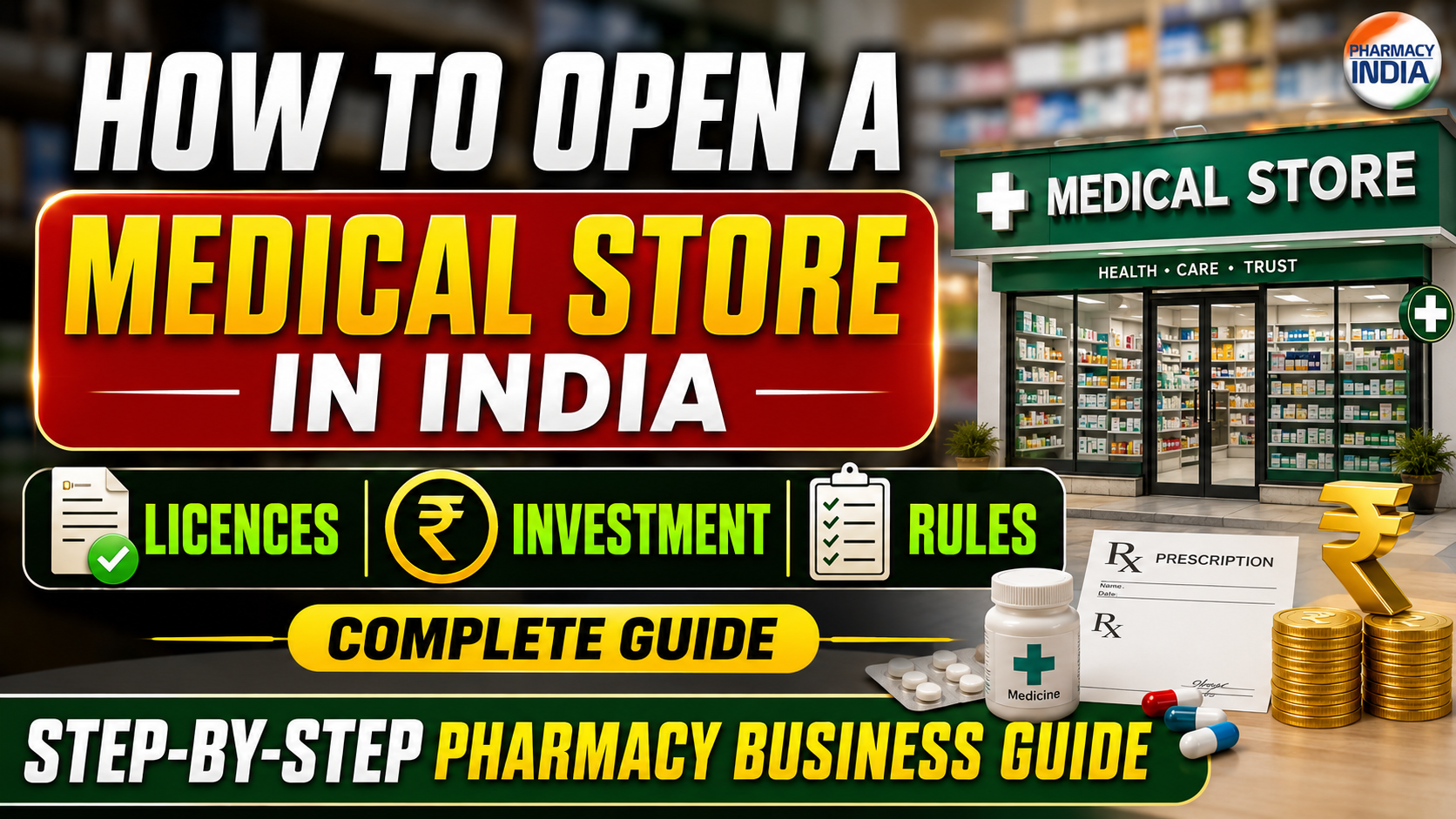
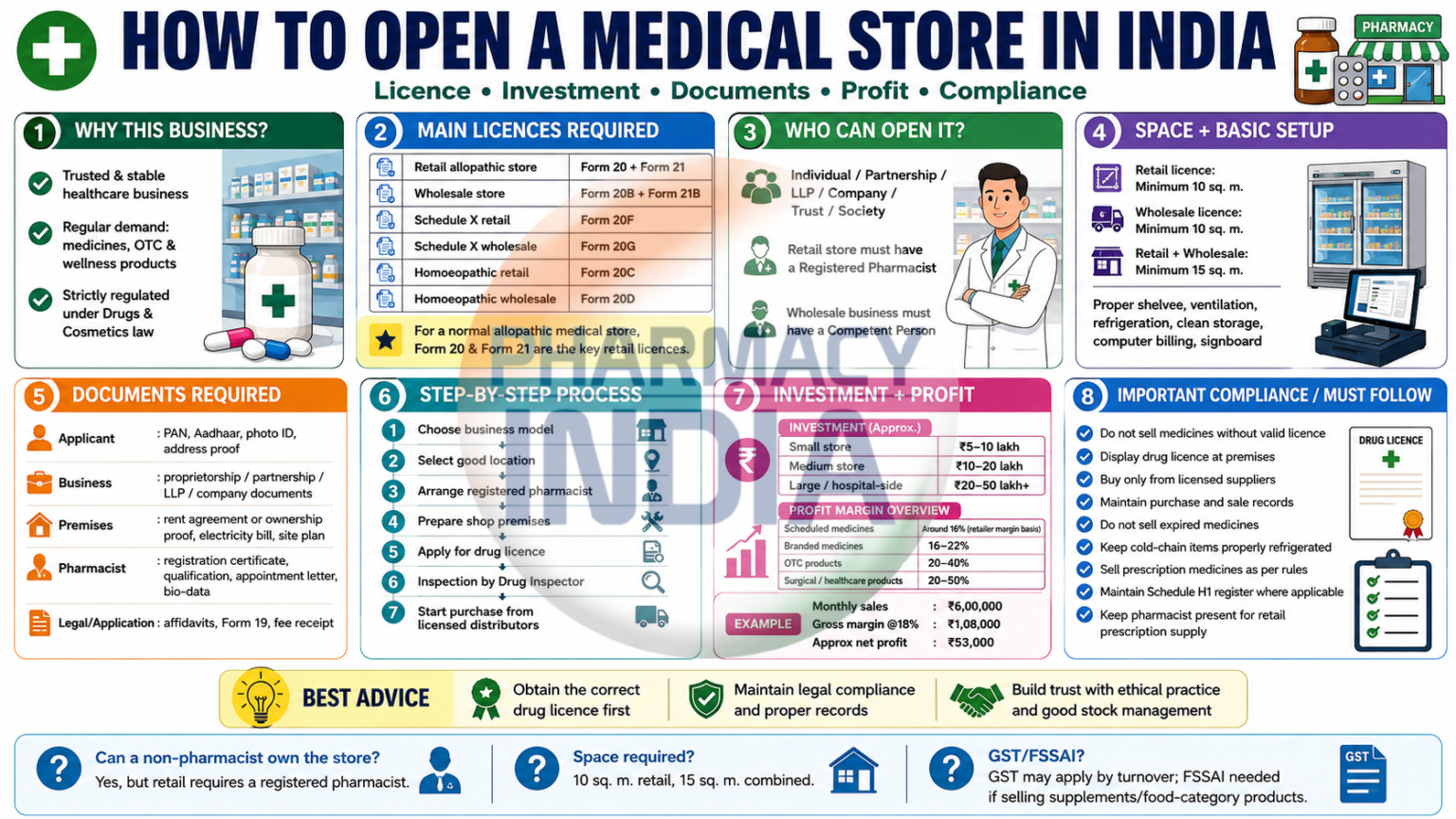
How to Open a Medical Store in India: A Complete In-Depth Guide for Pharmacy Professionals
A detailed roadmap covering Licences, Requirements, Investment, and Compliance
Opening a medical store in India is a highly trusted and stable business because healthcare products and medicines remain in constant demand. However, unlike general retail, this business is strictly governed by the Drugs and Cosmetics Act, 1940 and the Drugs Rules, 1945. This guide provides an in-depth analysis for pharmacy students and entrepreneurs looking to enter this sector.
1. Types of Medical Store Licences in India
Depending on your business model, you must apply for specific licences from the State Drug Control Department or State FDA.
| Type of Business | Required Licence Form | Purpose of Licence |
|---|---|---|
| Retail Medical Store | Form 20 and Form 21 | For selling allopathic medicines directly to patients/customers. |
| Wholesale Medicine Business | Form 20B and Form 21B | For selling medicines to retailers, hospitals, and clinics. |
| Schedule X Drugs (Retail) | Form 20F | For retail sale of narcotics and psychotropic substances. |
| Schedule X Drugs (Wholesale) | Form 20G | For wholesale distribution of Schedule X drugs. |
| Homoeopathic Store | Form 20C (Retail) / 20D (Wholesale) | Specifically for homoeopathic medicine sales. |
2. Eligibility and Professional Requirements
The Drugs Rules mandate strict professional supervision for the sale of medicines:
- For Retail Pharmacy: It is mandatory to have a Registered Pharmacist present to supervise prescription handling and medicine dispensing.
- For Wholesale Business: The premises must be managed by a competent person who may be a registered pharmacist or an individual with specific qualifications and experience in drug handling.
3. Minimum Space and Infrastructure Requirements
The premises must meet specific area and storage standards to ensure the quality and efficacy of medicines.
| Licence Category | Minimum Area Required | Storage Requirements |
|---|---|---|
| Retail or Wholesale Licence | 10 Square Metres | Must have Refrigerator, Proper Racks, Ventilation, and clean shelves. Cold-chain storage is mandatory for vaccines and insulin. |
| Combined Retail + Wholesale | 15 Square Metres |
4. Documents Required for Application
The documentation process is critical for a successful drug licence approval.
| Category | Documents Needed |
|---|---|
| Applicant Documents | PAN Card, Aadhaar Card, Photo ID, and Address Proof. |
| Business Documents | Partnership Deed, LLP Agreement, or Company Incorporation Documents. |
| Premises Documents | Rent Agreement/Ownership Proof, Electricity Bill, Site Plan, and Key Plan. |
| Pharmacist Documents | Registered Pharmacist Certificate, Qualification certificates, and Appointment letter. |
| Legal Declarations | Non-conviction affidavit and Proprietor/Director declaration. |
5. Step-by-Step Process to Start
- Choose Business Model: Decide between Retail, Wholesale, or Generic store models.
- Select Location: Prioritize locations near hospitals, clinics, or high-footfall residential areas.
- Appoint Pharmacist: Hire a pharmacist registered with the State Pharmacy Council.
- Prepare Shop: Install racks, refrigeration, and a computer billing system.
- Apply for Licence: Use the Form 19 for retail/wholesale applications via the State ONDLS portal.
- Inspection: A Drug Inspector will visit to verify the premises and documents.
6. Investment Analysis (Estimated)
Starting a medical store requires capital for inventory, infrastructure, and legal compliance.
| Expense Head | Approximate Investment (INR) |
|---|---|
| Shop Security Deposit / Rent | ₹50,000 – ₹5,00,000 |
| Interior, Racks, and Signboard | ₹1,00,000 – ₹4,00,000 |
| Initial Medicine Stock | ₹3,00,000 – ₹15,00,000 |
| Licencing & Professional Fees | ₹20,000 – ₹1,00,000 |
| Working Capital Reserve | ₹2,00,000 – ₹10,00,000 |
7. Profit Margins and Revenue
Profitability varies by product category and government regulations like DPCO 2013.
| Product Category | Approximate Gross Margin |
|---|---|
| Price-Controlled Medicines | 16% (Fixed by NPPA) |
| Branded Prescription Medicines | 16% – 22% |
| Generic Medicines | High margin (Varies widely) |
| OTC & Surgical Products | 20% – 50% |
Important Compliance Checklist:
- Maintain Schedule H1 Register for specific antibiotics and drugs.
- Ensure the drug licence is displayed prominently at the store.
- Keep records of purchase bills and sales for at least 3 years.
- Never sell expired medicines; keep them in a separate “not for sale” area.
© 2025 Pharmacy Career & Business Portal. All information is based on the Drugs and Cosmetics Act of India.