Medical Coding Complete Career Guide 2025: A Professional Path for Pharmacy Students
The language of healthcare documentation, billing, and global clinical standards.
1. Introduction to Medical Coding
| What is Medical Coding? | |
|---|---|
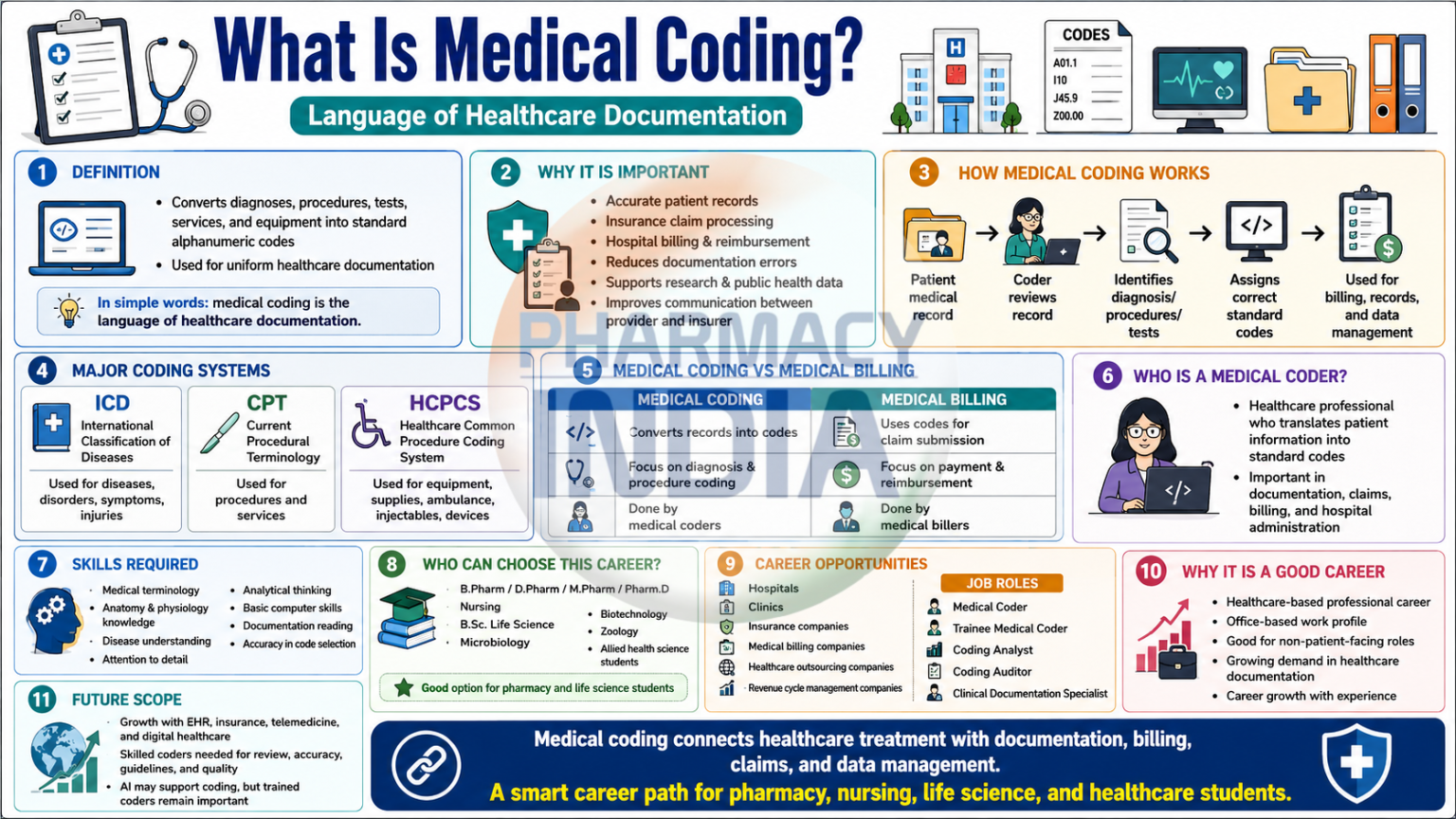
| Core Concept | Medical coding is the “language of healthcare documentation.” It is the process of converting medical diagnoses, procedures, treatments, laboratory tests, and healthcare equipment into standard alphanumeric codes. |
| Objective | To translate complex medical descriptions into a short, accurate, and uniform format that can be understood by hospitals, insurance companies, and government agencies globally. |
| Example | Instead of writing a long note for Diabetes Mellitus, a specific ICD Code is assigned to ensure the record is processed accurately for billing and research. |
Why Medical Coding is Essential
| Importance of Coding | Impact on Healthcare System |
|---|---|
| Insurance Claims | Facilitates the smooth processing of health insurance claims and reimbursements. |
| Error Reduction | Significantly reduces errors in healthcare documentation and patient records. |
| Disease Tracking | Helps in tracking disease patterns, treatment outcomes, and public health data. |
| Hospital Billing | Supports Revenue Cycle Management (RCM) by connecting clinical care with finances. |
2. Major Medical Coding Systems (ICD, CPT, HCPCS)
| System Name | Full Form | Primary Use & Examples |
|---|---|---|
| ICD Codes | International Classification of Diseases | Used to classify diseases, symptoms, and injuries. (e.g., Asthma, Hypertension, Tuberculosis). |
| CPT Codes | Current Procedural Terminology | Used for medical procedures and services. (e.g., Surgery, Radiology, Diagnostic Tests, Consultation). |
| HCPCS Codes | Healthcare Common Procedure Coding System | Used for medical products, equipment, and drugs. (e.g., Ambulance services, Injectable drugs, Prosthetics). |
Difference Between Medical Coding and Medical Billing
| Feature | Medical Coding | Medical Billing |
|---|---|---|
| Definition | Converts medical records into Standard Codes. | Uses codes to Prepare/Submit Claims. |
| Primary Focus | Diagnosis & Procedure identification. | Payments & Reimbursements. |
| Step in Process | Coding comes First. | Billing follows the Coder’s work. |
| Knowledge Area | Terminology & Anatomy. | Billing Rules & Insurance Policies. |
3. Career Path for Pharmacy & Life Science Students
Why Pharmacy students are the best fit for Medical Coding:
Pharmacy graduates possess deep knowledge of Pharmacology, Anatomy, Pathophysiology, and Drug Therapy, which allows them to understand complex medical records more easily than other graduates.
| Eligibility Criteria | Common Job Roles | Top Hiring Companies |
|---|---|---|
|
|
|
Skills Required to Succeed
- Attention to Detail: Small mistakes lead to claim rejections.
- Analytical Thinking: Ability to interpret doctor’s notes accurately.
- Anatomy & Physiology: Strong foundation in how the human body works.
- MedDRA & Coding Guidelines: Mastery of international coding rulebooks.
Conclusion
Medical coding is more than just codes; it is the bridge between medical treatment and healthcare administration. For Pharmacy students who prefer a professional, office-based career without direct patient handling, medical coding offers a stable and high-growth path in the global healthcare industry.