Complete Career Guide: Drug Analyst | Pharmacy India
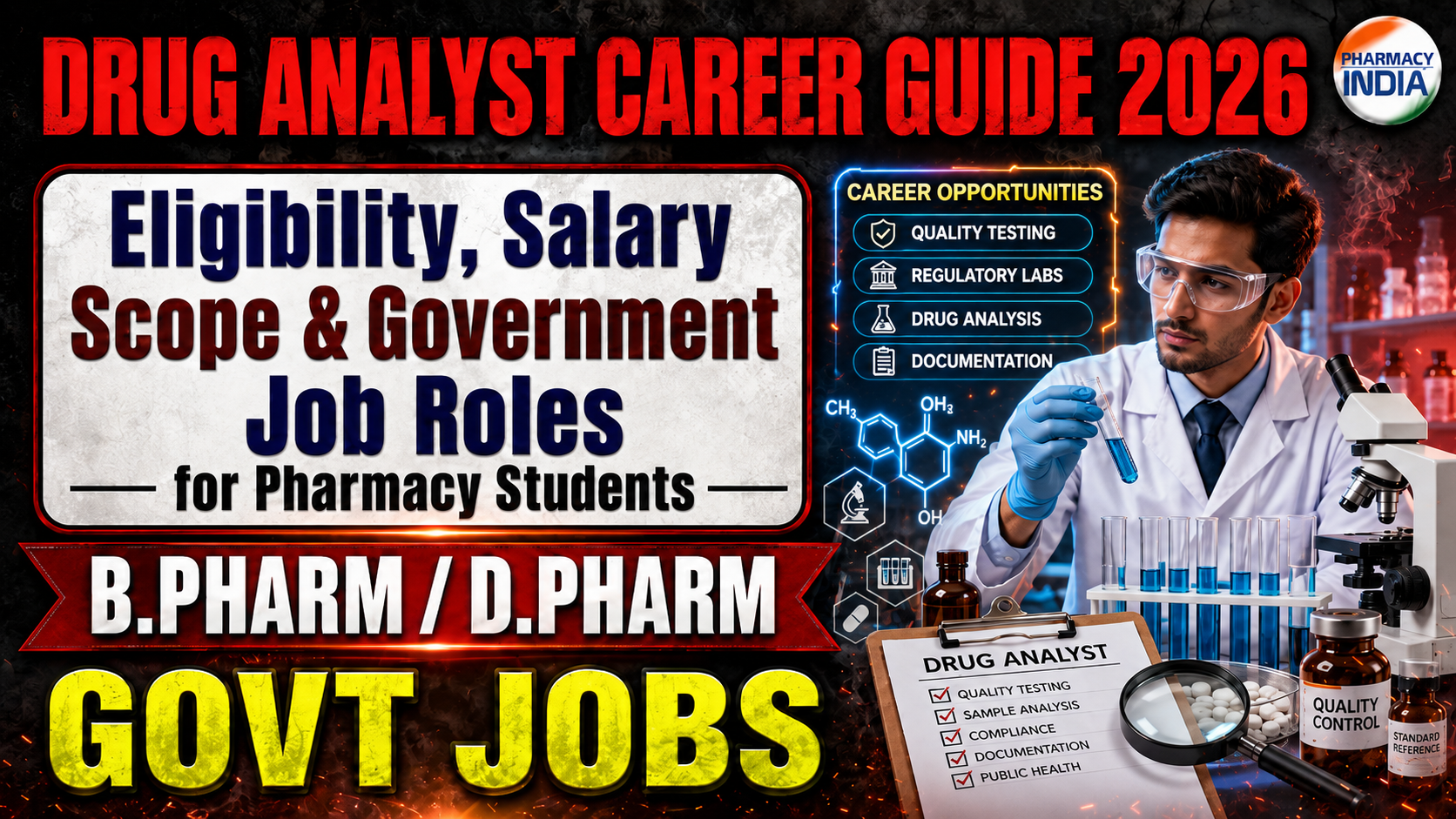
Drug Analyst Career Guide: Eligibility, Salary, Scope & Responsibilities
A Drug Analyst is a highly skilled pharmaceutical professional responsible for testing and analyzing drugs, cosmetics, and medical devices. Their primary goal is to verify quality, purity, safety, strength, and strict compliance with official standards. In India, this role is a cornerstone of the Drugs and Cosmetics Act, ensuring that every medicine reaching a patient is scientifically validated.
1. Core Responsibilities & Duties
Key Responsibility
Detailed Description of Work
Drug Sample Testing
Verifying if the drug contains the correct Active Pharmaceutical Ingredient (API) and meets the stated label strength.
Identifying substandard, adulterated, misbranded, or spurious drugs to protect public health.
Pharmacopoeial Compliance
Ensuring all products strictly follow standards set by IP (Indian Pharmacopoeia), BP, USP, and other international bodies.
Report Preparation
Drafting official analytical reports used for batch release or legal regulatory actions against manufacturers.
2. Analytical Instruments Used
Modern Drug Analysts must be experts in handling high-end laboratory equipment to ensure accuracy in calculations and data interpretation.
Instrument Name
Primary Application / Use
HPLC (High-Performance Liquid Chromatography)
Assay, impurity testing, and complex drug content analysis.
UV-Visible Spectrophotometer
Quantitative analysis and identification of substances.
GC (Gas Chromatography)
Analysis of volatile substances and residual solvents.
FTIR Spectroscopy
Identification of functional groups and chemical fingerprinting.
Dissolution Apparatus
Testing how a drug releases from its dosage form over time.
Karl Fischer Titrator
Precise determination of moisture/water content in samples.
3. Eligibility & Education Qualifications
As per Rule 44 of the Drugs and Cosmetics Rules, the following qualifications are required for appointment as a Government Analyst:
Requirement Type
Accepted Degrees & Criteria
Primary Degrees
B.Pharm, M.Pharm, B.Sc Chemistry, M.Sc Chemistry, or Medicine.
Specializations
Pharmaceutical Chemistry, Microbiology, Biotechnology, or Pharmacology.
Experience
Post-qualification experience in drug testing or analytical laboratories is often mandatory for government posts.
Key Skills
Knowledge of GLP (Good Laboratory Practice), GMP, and high attention to detail.
4. Career Scope & Job Opportunities
Public Sector (Government)
CDSCO Laboratories: Working under the Central Drugs Standard Control Organization.
State Drug Control: Serving as a Government Analyst or Scientific Officer.
Pharmacopoeia Commission: Helping set national drug standards.
Private Sector (Pharmaceutical Industry)
Common Job Titles
Work Environment
QC Analyst / QC Chemist
Manufacturing Plants & Batch Testing.
Analytical Development Scientist (ADL)
Research & Development (R&D) Centers.
Stability Analyst
Monitoring drug shelf-life and degradation.
Microbiology Analyst
Sterility testing and microbial limit tests.
5. Difference: Drug Analyst vs. Drug Inspector
Point of Difference
Drug Analyst
Drug Inspector
Primary Work
Laboratory testing and scientific analysis.
Inspection, sampling, and law enforcement.
Workplace
Drug testing laboratories (Indoor).
Fieldwork, pharmacies, and factories (Outdoor).
Nature of Job
Scientific and Analytical.
Regulatory and Administrative.
Report Type
Issues Analytical Test Reports.
Takes Legal/Regulatory Action based on reports.
6. Step-by-Step Path to Become a Drug Analyst
1. 10+2 Education: Complete with Physics, Chemistry, and Biology/Maths.
2. Graduation: Pursue B.Pharm or B.Sc in Chemistry.
3. Skill Acquisition: Master Pharmaceutical Analysis and instrumental methods.
4. Training: Get hands-on experience with HPLC, GC, and Dissolution testers.
5. Experience: Work in a QC department or a government-approved testing lab.
6. Certification: Keep updated with latest USP/IP/BP methods and GLP guidelines.
Conclusion: The role of a Drug Analyst is vital for the pharmaceutical quality system. Without their expertise, the safety of the healthcare system would be at risk. This career offers stability, high respect, and the opportunity to protect public health through science.