Pharmacovigilance Career Opportunities 2025 | Detailed Guide & Vacancies
Career in Pharmacovigilance (PV) – 2026 Comprehensive Guide
In-depth understanding of drug safety, adverse reaction monitoring, and regulatory compliance for Pharmacy students.
1. Understanding Pharmacovigilance (PV)
Pharmacovigilance Definition & Scope
Scientific Definition
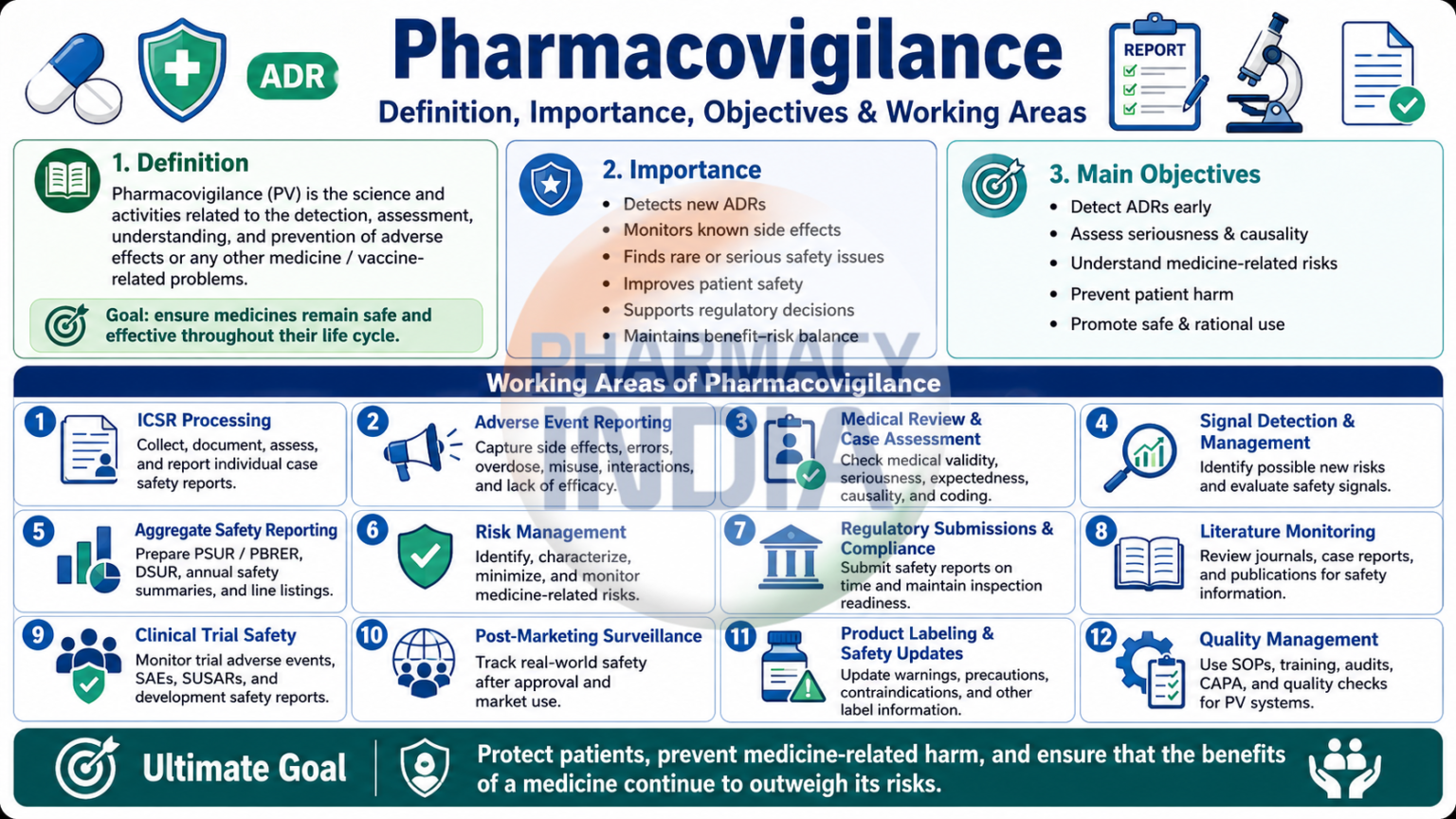
Pharmacovigilance (PV) is the science and activities related to the detection, assessment, understanding, and prevention of adverse effects or any other medicine/vaccine-related problems.
Core Purpose
To ensure that medicines are used safely and effectively throughout their entire life cycle (from development to marketing).
Primary Goal
To identify and control harmful, unexpected, or serious effects at the right time to protect patient health.
Key Importance of Pharmacovigilance in Industry
Before approval, drugs are tested on limited populations. PV is critical because once a medicine is marketed, it is used by a larger and more diverse population where rare and long-term reactions appear.
Pharmacovigilance Helps In…
Strategic Impact
Identifying new adverse drug reactions (ADRs).
Supports patient safety updates.
Monitoring known side effects and frequency.
Maintains a positive benefit-risk balance.
Detecting serious or rare safety issues.
Prevents avoidable harm.
Supporting regulatory decisions and label changes.
Ensures legal and medical compliance.
2. Professional Working Areas in Pharmacovigilance
This section details the 12 core domains where Pharmacy graduates work as PV Associates or Drug Safety Officers.
Domain Area
Key Responsibilities & Functions
1. ICSR Processing
Involves collection, documentation, and reporting of Individual Case Safety Reports. Contains patient info, suspected medicine, and causality assessment.
2. Adverse Event Reporting
Collecting data on side effects, medication errors, overdose, misuse, and lack of efficacy.
3. Medical Review
Checking clinical accuracy, medically validating cases, and ensuring correct Medical Coding (MedDRA).
4. Signal Detection
Identifying new risks or aspects of known risks. Communicating findings to regulatory authorities.
5. Aggregate Reporting
Preparing periodic reviews like PSUR (Periodic Safety Update Report) and PBRER for regulatory submission.
6. Risk Management
Preparing Risk Management Plans (RMP) and planning minimization measures like warnings and contraindications.
7. Regulatory Compliance
Ensuring submission of serious and non-serious ICSRs within defined legal timelines.
8. Literature Monitoring
Monitoring medical journals, case reports, and scientific publications for safety signals.
9. Clinical Trial Safety
Monitoring SAE (Serious Adverse Events) and SUSAR reported during drug development phases.
10. Post-Marketing Surveillance
The “Cornerstone” of PV—detecting long-term safety issues in the real-world market.
11. Product Labeling
Updating indications, warnings, and precautions based on cumulative safety data.
12. Quality Management
Managing SOPs, Training records, and Audits to ensure consistent safety monitoring.
3. Eligibility & Educational Qualifications
Qualification Level
Relevant Degree / Field
Primary Eligibility
B.Pharm, Pharm.D, or M.Pharm (Pharmacology preferred).
Medical Field
MBBS, BDS, or BHMS/BUMS (for Medical Reviewer roles).
Skills Required
Knowledge of MedDRA, Argus/ArisG databases, and ICH-GCP guidelines.
Pharmacovigilance is a critical function in the pharmaceutical industry. Its ultimate goal is to protect patients, prevent medicine-related harm, and ensure that the benefits of a medicine continue to outweigh its risks from clinical development to post-marketing use.